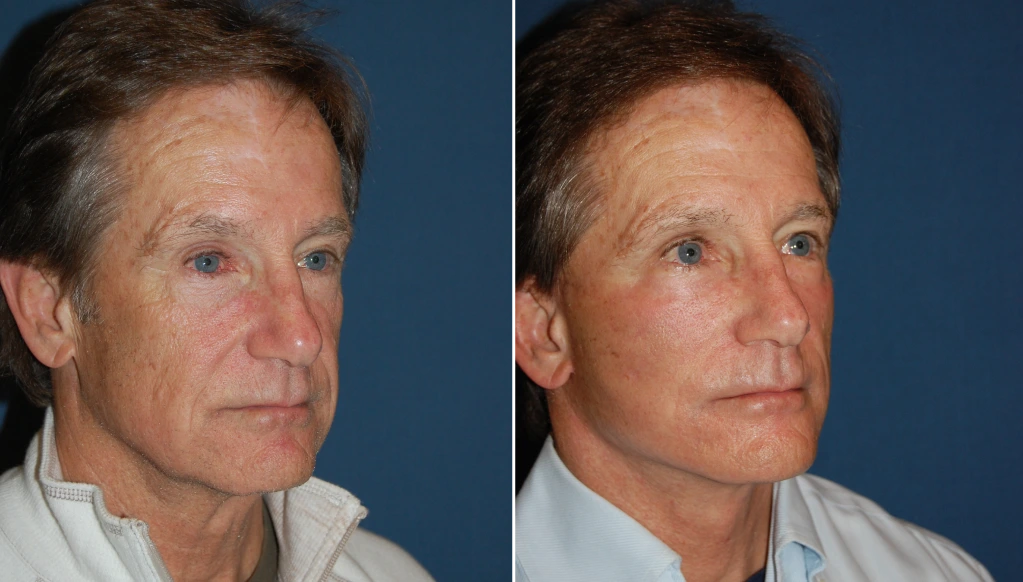
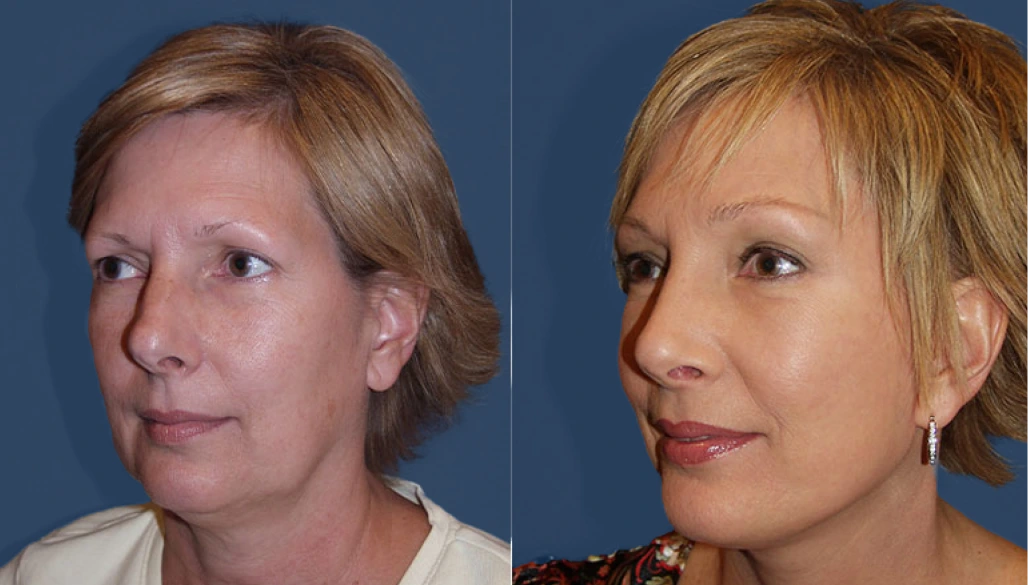
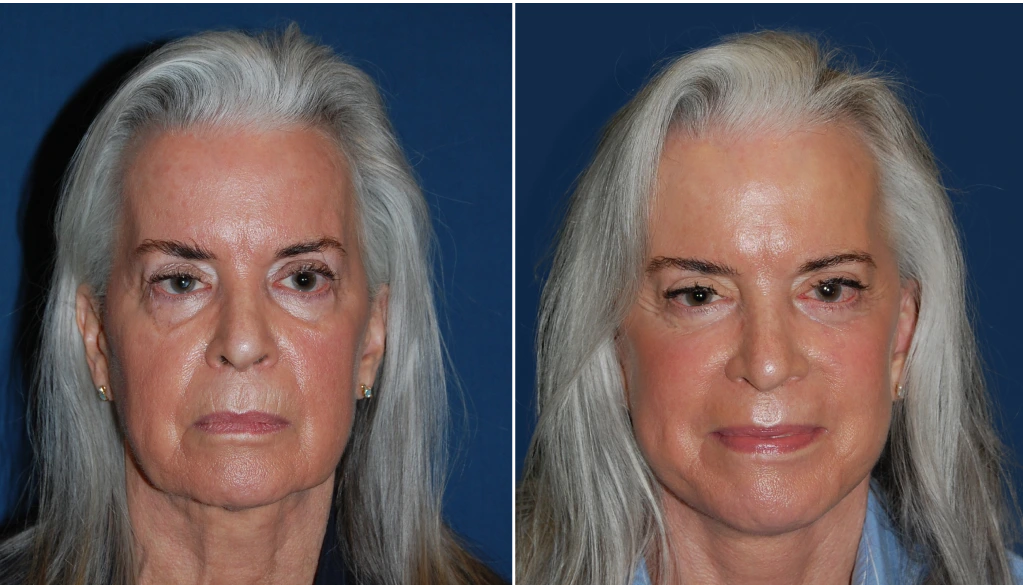
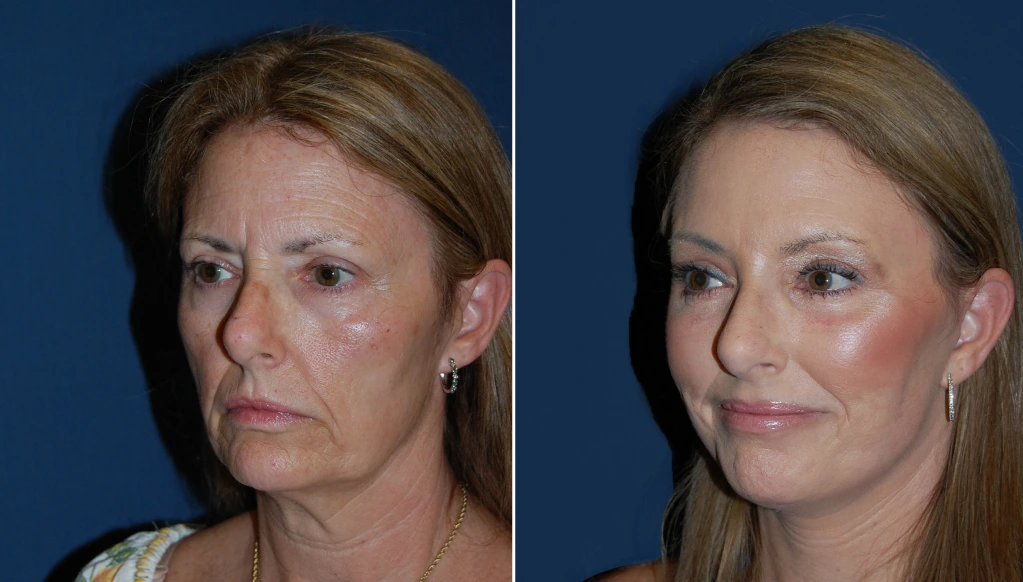
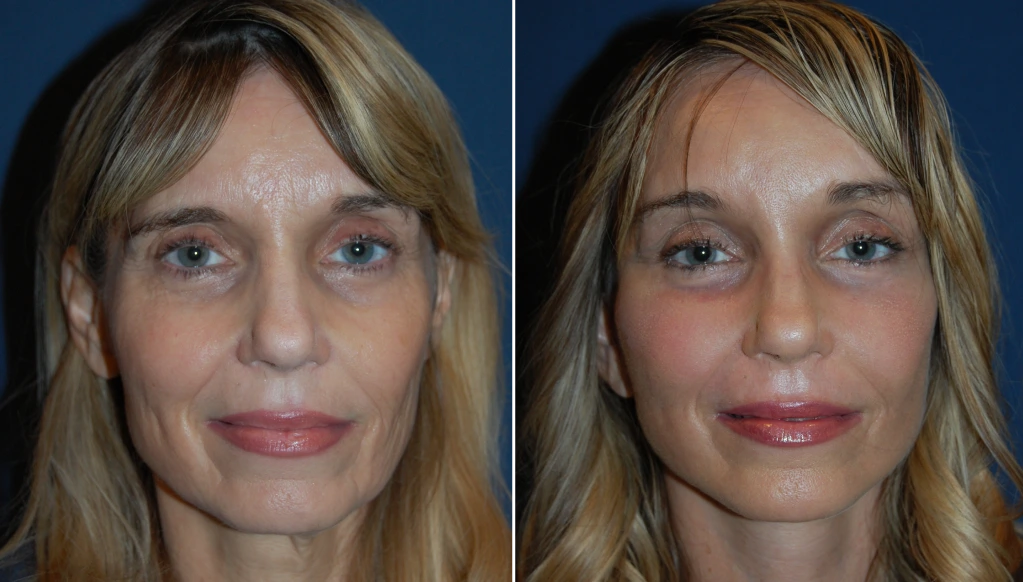
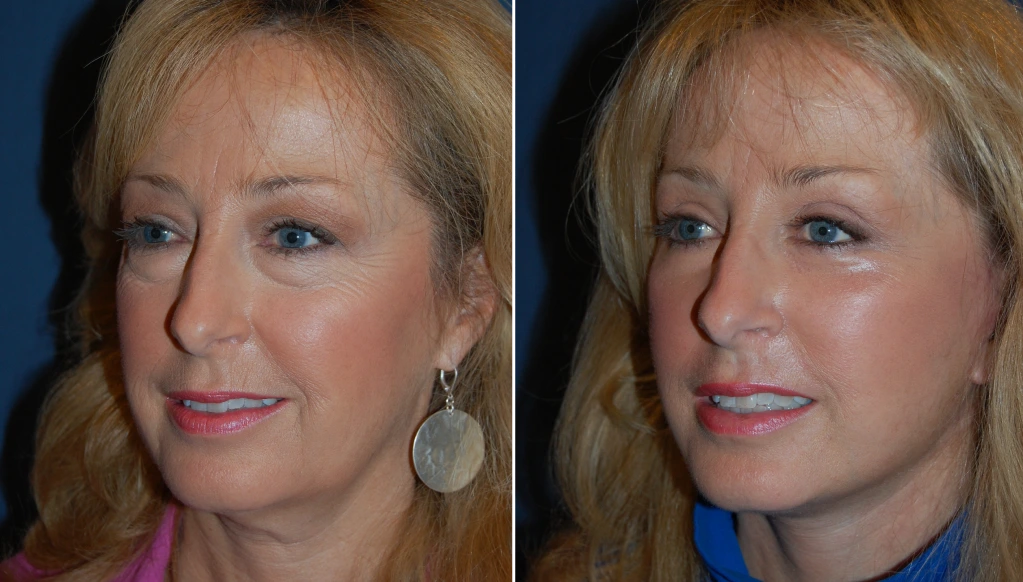
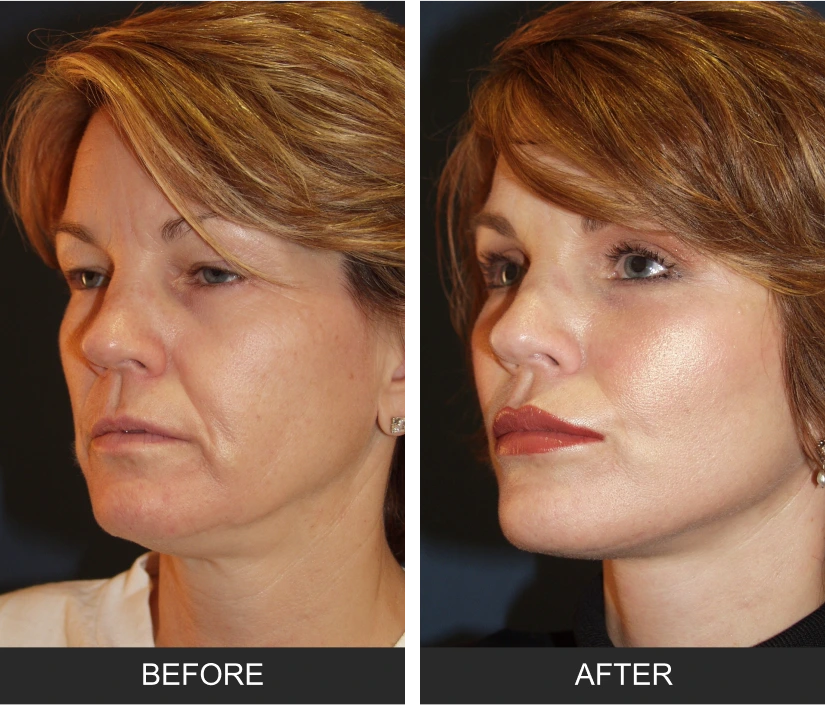
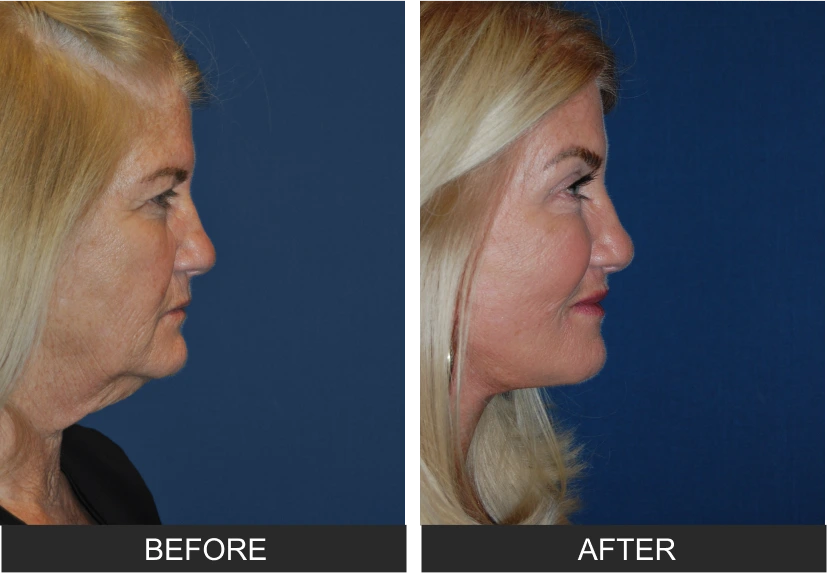
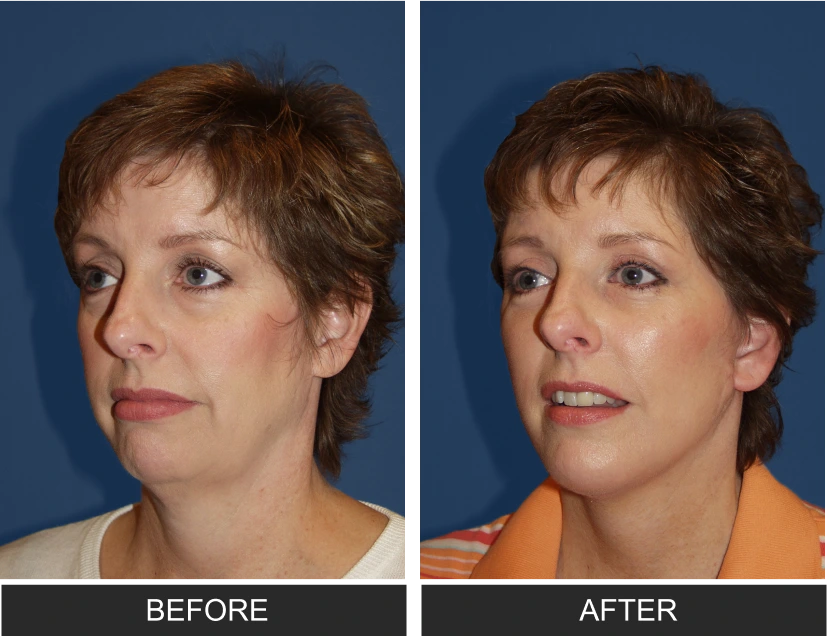



Dr. Sean Freeman has performed facelifts in Charlotte since 1988 and only operates on faces. He offers three operations and will tell you at your consultation which one your anatomy needs: the Preservation Deep Plane Facelift with neck lift for established jowls and neck laxity, his lighter MiniTuck facelift for mild to moderate sagging, and the Signature Lift he developed for younger patients or those whose earlier facelift is aging. Our gallery holds 70 facelift cases photographed in our office, and the surgery takes about four hours with you home the same day.
A facelift (rhytidectomy) repositions the deeper tissue of the cheeks, jawline and neck and removes the skin that has become excess, restoring the contour you had ten to fifteen years ago. What separates Dr. Freeman’s facelifts from the “pulled” look is that the lifting is done in the deeper layers (the SMAS and, in the deep plane lift, beneath it) while the skin is simply redraped, so the hairline, earlobes and smile stay natural. He has performed deep plane facelifts for more than 20 years, lectures and publishes on the technique, and frequently combines a facelift with his SOOF lift lower blepharoplasty, his Segmental Endoscopic Brow Lift or CO2 laser resurfacing in the same session.
At Only Faces, we use a range of Facelift techniques to combat various signs of facial aging. Techniques differ in how incisions are made, how tissues are lifted and repositioned, and how deep the lift goes. Here is a detailed overview:
Dr. Freeman’s Facelift is a less invasive alternative to the traditional Deep Plane Facelift. With this procedure, an incision is made around the ears and a small one under the chin. It is perfect for patients who have only mild to moderate sagging in their midface, perioral (around the mouth) area, and neck. The procedure improves the midface without requiring any fat injections. This way, patients can get natural-looking results that take years off their faces.

Dr Freeman’s Facelift with Neck Lift is one of the most advanced Facelift techniques available. He performs this procedure by making incisions that extend from the ear to the temples along the hairline. By delicately repositioning the deeper facial tissues, he is able to achieve a tighter and more youthful appearance without causing a stretched appearance (as can happen with other methods). This method also requires a minor cut beneath the chin. This way, excess fat from the neck can be removed via liposculpture, and the mandibular ligament can be loosened. That kind of Facelift is perfect for individuals whose cheeks, jawline, and neck have sagged considerably.

Developed by Dr. Freeman, the Signature Lift is more advanced than what the media dubs a “weekend” Facelift. It is intended for younger patients who don’t yet need a full Facelift. It is also an option for those who’ve had a Facelift before and now see new signs of aging. The neck and jowls are the focus of the Signature Lift. It gives patients a youthful look with less recovery time than that of a traditional Facelift. This surgery is typically done under anesthesia., Most patients get back to their regular activities within about five to seven days.

During the first meeting, Dr. Freeman examines the patient to decide which Facelift technique would be best for them. He evaluates factors such as the patient’s facial structure, the elasticity of their skin, and how much it sags or wrinkles. Dr. Freeman also takes photos so they can compare them with how they look after surgery.

On the day of surgery, Dr. Freeman marks the patient’s face to indicate where incisions are to be made. This way, he can get the best outcomes with minimal scarring. Next, the patient meets with Dr. Freeman’s anesthesia personnel. They will make sure they don’t feel any discomfort while having your operation.
Next, Dr. Freeman makes exact incisions according to the Facelift method chosen and previous markings. For example, in a Preservation Deep Plane Facelift, these usually run from the temples to hidden contours around the ear and then, behind the ear back into the hair line. He makes a small incision under the chin to help with improving patients jowling.. Next, Dr. Freeman elevates and repositions the face’s deeper tissues. These include fat, muscles, and connective tissue. This way, he creates youthful facial contours before trimming any excess skin.
After repositioning the facial tissues and achieving the desired contours, Dr. Freeman uses sutures for the skin and staples in the hair to carefully close the incisions. The whole procedure typically takes about four hours, depending on how complex it is.

Patients frequently choose to have a lower lid blepharoplasty using Dr Freeman’s state of the art SOOF lift technique at the same time as a deep plane Facelift. It can help give an all-round rejuvenation by improving puffiness (bags) under the eye and hollowness under the lower lid. This procedure not only helps these issues but also helps lift the midface, which improves midface rejuvenation along with the deep plane facelift. Should both procedures be done simultaneously it may require a longer recovery. However, the outcomes are amazing and give patients a significantly younger look.

After a Facelift surgery, patients are closely monitored in our comfortable facility as they wake up from anesthesia. Patients that live nearby go home after a few hours. Most out of town patients stay in conveniently located hotels that are accustomed to our patients. We recommend that the patient have assistance with their care for at least three days. It is common to feel a bit sore, tight, and swollen right after surgery. We offer pain management medication and post-operative care to help ensure a patient’s comfort throughout the process.
During the initial weeks after getting a Facelift, patients are advised not to engage in strenuous activities and to keep their head elevated. This way, they can lessen swelling and encourage the recovery process. Dr. Freeman uses dressings for a Facelift for 48 hours only. Stitches are typically taken out at day six and the rest one week later. Two weeks afterwards patients are allowed to do light exercise and can begin wearing sunscreen and makeup. After six weeks they can start strenuous exercise. In the unusual event where there is an infectious process, our expert may prescribe additional medications.
Over the next few weeks, patients will notice that swelling and bruising gradually goes down. However, it might take around three months before they can see the full effects of their facelift. Each situation is personalized. In any case, we suggest our patients have regular check-ups with Dr. Freeman. This way, he can answer their questions, see how recovery goes, and suggest any care procedures.
A Facelift is an option worth considering for patients who have begun to notice signs of aging on the face and would like a younger-looking appearance. Several factors typically make someone a good candidate for this type of procedure:
This is why most people get Facelifts. They have significant amounts of loose skin, deep creases, jowls, and drooping muscle tone in the face and neck. These issues can be caused by things like genetics, environmental factors, or just getting older.

When getting a Facelift, it is helpful to have good skin elasticity. It enables the skin to adjust to its lifted position post-surgery.
A strong bone structure helps support the facial tissues and can make a difference in the results of a Facelift. People with well-defined cheekbones and jawlines may get better "lift" from surgery than those without.

Major weight fluctuations following the procedure can impact results—possibly causing more drooping or excess skin. So, having a stable weight is encouraged.

Using nicotine products can slow down healing and raise the chance of complications. So, we require quitting smoking 2 weeks before surgery and 2 weeks after.

Sagging skin, jowls, deep wrinkles – these are just a few of the telltale signs of aging that a Facelift can effectively reduce. By lifting and firming slack facial tissues, it can “erase” years from a patient’s face. This way, they look naturally rejuvenated.
Dr. Sean Freeman has developed Facelift methods that produce natural results. Instead of looking stretched or operated on, the intention is to improve aspects of a patient’s face in a way that stays true to each individual patient.
In contrast to non-surgical options, which might need regular maintenance, the effects of a Preservation deep plane Facelift can last significantly longer. With results often still apparent for decades after surgery, this solution provides prolonged relief from the effects of aging.
Getting a Facelift can transform a patient physically and give their self-esteem a big boost. If their looks improve and problem areas are greatly improved, they should feel better in just about every situation – from posing for holiday snapshots to negotiating with their boss.
The first video is Dr. Freeman explaining when a MiniTuck is enough and when a full deep plane facelift is the right call. The second shows his MiniTuck facelift in Charlotte. All 70 facelift cases are in the gallery with their post-op dates.
MiniTuck versus facelift: which do you need?
The Charlotte MiniTuck facelift
A facelift with Dr. Freeman in Charlotte costs $25,000 to $40,000, all-inclusive: surgeon, anesthesia team, operating room and every follow-up visit. The MiniTuck sits at the lower end; the Preservation Deep Plane Facelift with neck lift runs $34,000 to $45,000 and has its own page. Adding eyelid surgery, a brow lift or laser resurfacing in the same session changes the total, and you receive one written quote at your consultation.
$25,000 to $40,000 at Only Faces, all-inclusive. A Preservation Deep Plane Facelift with neck lift is $34,000 to $45,000. You receive a written quote after the consultation.
Dr. Freeman’s facelift patients range from their 40s to their late 70s. The MiniTuck and Signature Lift suit earlier, milder changes; the deep plane lift suits established jowls and neck laxity. Anatomy decides, not age.
No. The lifting is done in the deep layers and the skin is only redraped, which is the whole point of the deep plane and MiniTuck techniques Dr. Freeman uses. See the “How to tell if someone has had a facelift” article on our blog for the signs he avoids.
Home the same day with a helper for three days; sutures out over two weeks; most patients back to work at two weeks and to full exercise at six weeks. Swelling continues to settle for about two months.
A deep plane facelift turns the clock back 10 to 15 years and you continue to age from there; most patients never need a second one. Those who do, often decades later, are candidates for the Signature Lift.
Yes, and most of Dr. Freeman’s patients do: the SOOF lift lower blepharoplasty, Segmental Endoscopic Brow Lift and CO2 laser resurfacing are routinely done in the same four-to-five-hour session.
Only Faces is at 11220 Elm Lane in south Charlotte, between Ballantyne and Pineville, a short drive from SouthPark, Matthews, Fort Mill and Rock Hill. Patients also travel from Huntersville, Lake Norman, Concord, Gastonia, Hickory and Winston-Salem; Dr. Freeman explains how out-of-town patients are managed in his video on the subject, and the office coordinates pre-op testing and follow-up around the drive. Call (704) 543-1110 or book online.
Dr. Sean Freeman, MD, FACS, is double board-certified by the American Board of Otolaryngology (1987) and the American Board of Facial Plastic and Reconstructive Surgery (1991). He completed his facial plastic surgery fellowship at Washington University in St. Louis under J. Regan Thomas, MD, and has operated in Charlotte since 1988, with hospital appointments at Atrium Health Carolinas Medical Center, Atrium Health Mercy and Novant Health Presbyterian. He has served on the editorial boards of Archives of Facial Plastic Surgery and Facial Plastic Surgery Clinics of North America, and Only Faces holds a 4.8-star rating across 140 Google reviews.
Patients choose Only Faces for a facelift because the three operations are matched to the face in front of him rather than one procedure sold to everyone, and because the results are on film: his YouTube channel and gallery show his Charlotte patients at two weeks, two months and a year.
